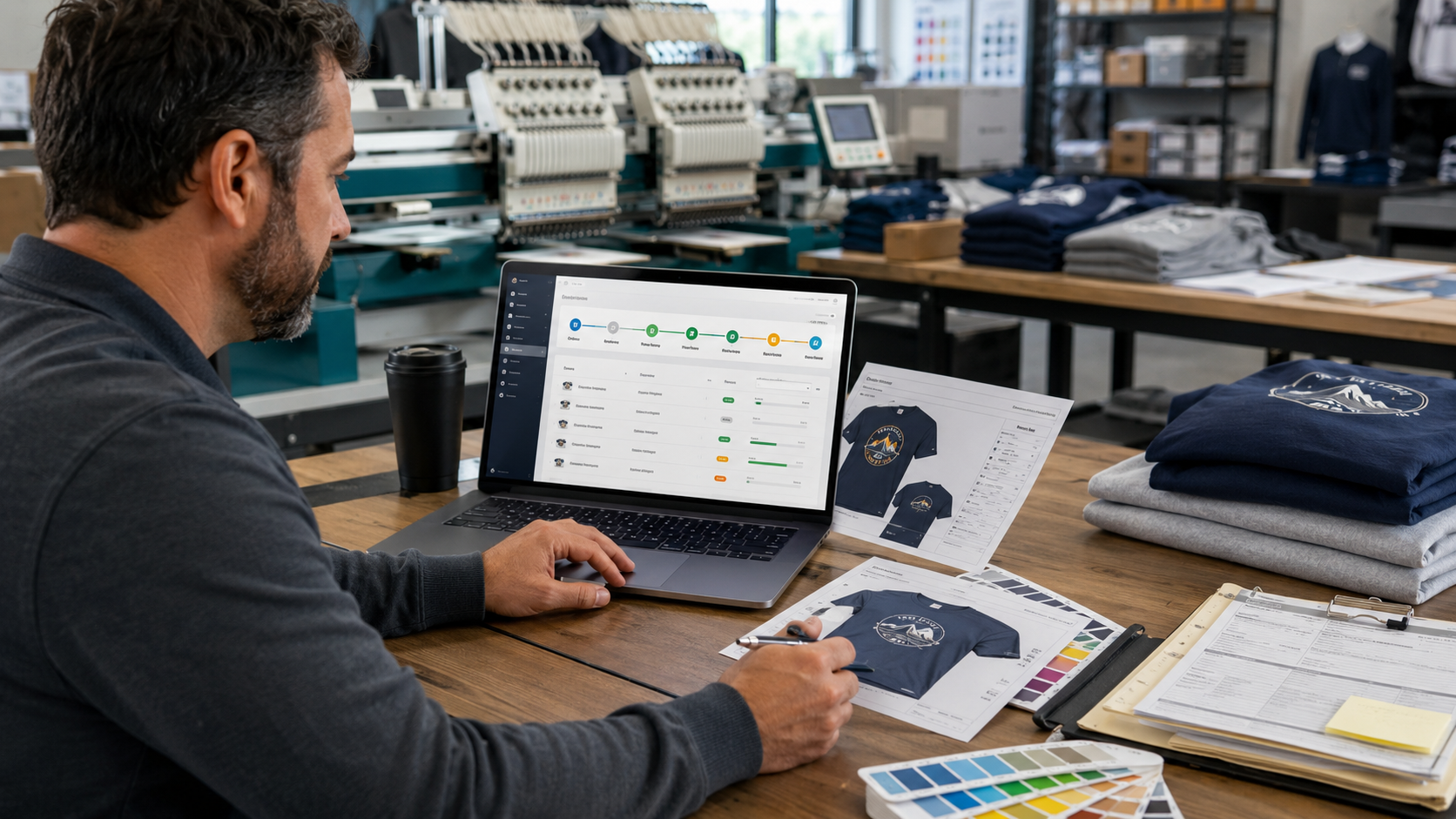
Decorated apparel shops don’t usually lose time because one person dropped the ball. They lose time because the work moves through too many disconnected handoffs.
A sales rep enters an order. Customer service clarifies garment details. The art team creates or updates a proof. The customer approves, requests changes, or doesn’t respond. Production needs to know what’s approved, what’s in stock, what’s scheduled, and what still needs attention. Meanwhile, the customer wants an update; the due date is approaching, and the team is trying to piece together the full picture from emails, spreadsheets, notes, and separate systems.
That’s where decorated apparel workflow problems really show up.
For screen printers, embroidery shops, digital decorators, promo product suppliers, and branded merchandise businesses, the biggest operational challenge isn’t just “managing orders.” It’s keeping every order moving smoothly from quote to fulfillment, without losing visibility across sales, artwork approvals, production scheduling, inventory coordination, and customer communication.
When that continuity breaks, shops feel it fast: missed deadlines, approval delays, production errors, rework, rush charges, frustrated customers, and stressed-out teams.
Where Apparel Production Bottlenecks Usually Start
Most apparel production bottlenecks don’t start on the press, embroidery machine, or heat press. They start earlier, when order details aren’t clear, approvals aren’t documented, or production doesn’t have the same information sales promised the customer.
Common bottlenecks include:
- Orders entered before the garment color, size breakdown, decoration method, or imprint location is finalized.
- Artwork proofs sitting in email threads without clear approval status.
- Production schedules built before inventory is confirmed.
- Customer changes communicated to one person but not reflected everywhere else.
- Sales, art, and production using different tools to track the same job.
- Customer service answering status questions manually because there’s no shared order visibility.
In a decorated apparel environment, a small information gap can create a major production delay. A missing thread color, an outdated logo file, an incorrect size matrix, or unapproved proof can stop a job from moving forward. Even worse, if the shop doesn’t catch the issue until production starts, the result may be spoiled garments, reprints, missed ship dates, or uncomfortable customer conversations.
This is why apparel production management needs more than a generic order system. Decorated apparel shops need workflow visibility that matches how their work actually moves: sales, art, approvals, purchasing, inventory, production, shipping, and customer updates, all connected to the same order.
Why do decorated apparel shops experience workflow bottlenecks?
Decorated apparel shops experience workflow bottlenecks because order information changes as it moves through the business, yet many shops lack a connected workflow that keeps every team updated in real time.
A customer may approve a quote but still need to approve the artwork. Inventory may be available when the quote is created, but backordered when the job is scheduled. Production may have the due date, but not the final decoration instructions. Sales may know the customer changed the imprint location, but the art team may still be working from the original request.
These aren’t unusual edge cases. They’re part of daily life in decorated apparel and promotional product businesses.
The problem is that many shops rely on disconnected tools to manage those details. Sales may live in one system, artwork in another, production in a spreadsheet, customer updates in email, and inventory in someone’s notes or vendor portal. That setup forces employees to become the “integration” between departments.
That’s risky because people are already busy. They’re quoting, ordering blanks, chasing approvals, answering customer questions, preparing art, scheduling machines, checking stock, and getting jobs out the door. When information must be carried manually from one stage to the next, delays are almost inevitable.
The Decorated Apparel Order Lifecycle: From Quote to Fulfillment
To understand where time gets lost, it helps to look at the full order lifecycle.
1. Quote and order intake
The workflow starts when a prospect or customer requests apparel, decoration, quantities, sizes, colors, locations, and delivery timing. At this stage, accuracy matters. If the quote doesn’t capture the right decoration method, garment details, pricing assumptions, or deadline expectations, the rest of the order starts on shaky ground.
2. Order entry and job setup
Once the order is approved, the shop needs to convert sales details into production-ready instructions. That may include size breakdowns, decoration placements, art files, vendor details, customer notes, due dates, and internal job requirements. This is often where problems begin if sales notes don’t translate cleanly into production tasks.
3. Artwork preparation
The art team needs the correct logo, garment color, imprint size, thread colors, ink colors, placement instructions, and any customer-specific brand requirements. If files are missing or instructions are unclear, the artwork approval workflow slows down before the customer even sees a proof.
4. Proof approval
Proofing is one of the biggest friction points in the decorated apparel workflow. Customers may approve quickly, request revisions, miss an email, or approve one version while someone else references another. Manual approval processes can slow down decorated apparel production timelines, especially when approvals are buried in inboxes rather than tied directly to the order.
5. Purchasing and inventory coordination
Before production can happen, the shop needs the right blanks, sizes, colors, and quantities. If purchasing and inventory aren’t connected to the order workflow, production may discover too late that garments are missing, substituted, or delayed.
6. Production scheduling
Scheduling depends on more than due dates. Shops need to know whether artwork is approved, garments are received, screens or embroidery files are ready, machines are available, and production steps are sequenced correctly. When scheduling happens separately from order and approval status, jobs can appear ready when they’re not.
7. Production and quality control
Once the job hits production, the team needs accurate instructions. Wrong art, outdated notes, missing approvals, or incorrect garment details can create production errors. Quality control is much easier when the production team can see the same approved information that sales, art, and customer service are using.
8. Shipping, fulfillment, and customer communication
The final stage still depends on visibility. Customers want to know when their order is complete, shipped, ready for pickup, or partially fulfilled. Order tracking and proof approval tools can reduce communication errors and missed deadlines by giving teams a clearer source of truth.
Why Generic Print MIS Conversations Miss the Apparel Workflow Problem
Many software conversations in the print industry focus on broad MIS or ERP functionality. That can be useful, but decorated apparel shops have different operational pressure points than commercial print shops.
Apparel decoration workflows are highly variable. A single order may involve multiple garment styles, sizes, decoration methods, imprint locations, proofs, revisions, vendor dependencies, and production steps. A promo product order may involve supplier lead times, artwork templates, customer approvals, and fulfillment requirements that don’t fit neatly into a generic print production model.
That’s why the conversation shouldn’t only be about “business management software.” It should be about workflow continuity.
For apparel decorators, the key question is:
Can every department see what needs to happen next, what’s already approved, what’s holding the order up, and who needs to act?
When the answer is no, the shop becomes dependent on tribal knowledge. The experienced production manager knows which customer always changes proofs. The CSR knows which rush order is waiting on a size swap. The art team knows which logo file is final. But if that knowledge isn’t visible in the workflow, it’s fragile.
How Connected Workflows Reduce Production Delays
Connected workflows reduce production delays by keeping sales, customer service, art, inventory, scheduling, production, and customer communication aligned around the same order.
Instead of each department managing its own version of the truth, a centralized workflow system gives teams shared visibility into order status, proof approvals, production readiness, inventory needs, and customer updates.
For decorated apparel shops, that can improve operations in several practical ways.
First, it reduces approval uncertainty. Clear proof status tracking keeps teams from searching email threads or asking, “Did the customer approve this yet?” A cleaner artwork approval workflow shows art and production teams when a job is ready to move forward.
Second, it improves scheduling accuracy. Disconnected sales, artwork approval, and scheduling systems often cause production delays. When schedulers can confirm garment receipt and artwork approval, they can build a more realistic production calendar.
Third, it helps prevent production errors. When approved artwork, order details, size matrices, production notes, and customer requirements stay connected, production teams are less likely to work from outdated information.
Fourth, it improves customer communication. Customers don’t want vague answers. They want to know where their order stands. Centralized workflow systems improve visibility across customer service, art, and production teams, which makes customer updates faster and more reliable.
Finally, workflow continuity can improve production efficiency and customer satisfaction in apparel businesses. When each step flows into the next without manual re-entry or constant status chasing, teams spend less time searching for information and more time moving jobs forward.
What Better Workflow Visibility Looks Like
Better workflow visibility doesn’t mean adding more dashboards for their own sake. It means giving each role the information they need, when they need it.
Sales should know whether an order has moved into art, proofing, or production.
Art should know which proofs are due, which files are missing, and which revisions are waiting.
Customer service should know whether a job is waiting on approval, inventory, production, or shipping.
Production should know what’s approved, what’s ready, what’s scheduled, and what has changed.
Management should know where jobs are getting stuck and which handoffs need improvement.
That kind of visibility is especially important as shops grow. A small team may be able to manage exceptions verbally for a while. But as order volume increases, informal communication breaks down. The shop needs a connected, decorated-apparel workflow that scales without adding more manual follow-up.
The Real Cost of Disconnected Apparel Workflows
Disconnected workflows don’t just waste time. They create operational drag across the whole business.
Every manual status check interrupts someone. Unclear approvals create risk. A disconnected schedule forces the production manager to make decisions with incomplete information. Each customer update that requires three internal messages slows the team down.
Over time, those small gaps become expensive. They reduce capacity, increase stress, and make it harder to deliver the consistent service customers expect.
For shop owners and production managers, the goal isn’t just to “go digital.” It’s to create a workflow where orders don’t disappear between departments.
That means connecting the full path from sales to approvals to production to fulfillment. It means making the next step visible. It means reducing the number of places employees have to check before they can confidently answer, “What’s happening with this order?”
Bringing Sales, Art, Production, and Customers Into One Workflow
The most efficient decorated apparel shops aren’t necessarily the ones with the most equipment or the biggest teams. They’re often the ones with the clearest workflow.
They know:
- Which orders are waiting on artwork
- Which proofs need customer approval.
- Which jobs are ready to schedule.
- Which garments are missing.
- What production needs today, tomorrow, and next week.
- How to communicate with customers without rebuilding the order story from scratch.
That’s the difference between managing tasks and managing workflow continuity.
For decorated apparel and promotional product businesses, connected workflow management tools can help close the gaps between sales, artwork approvals, production scheduling, inventory coordination, and customer communication.
If your team is losing time chasing approvals, checking order status, correcting preventable production errors, or manually updating customers, it may be time to look at tools designed around how apparel decoration actually flows.


